
Treadmill Parts Name Guide and When to Replace Each Part
 Fitness
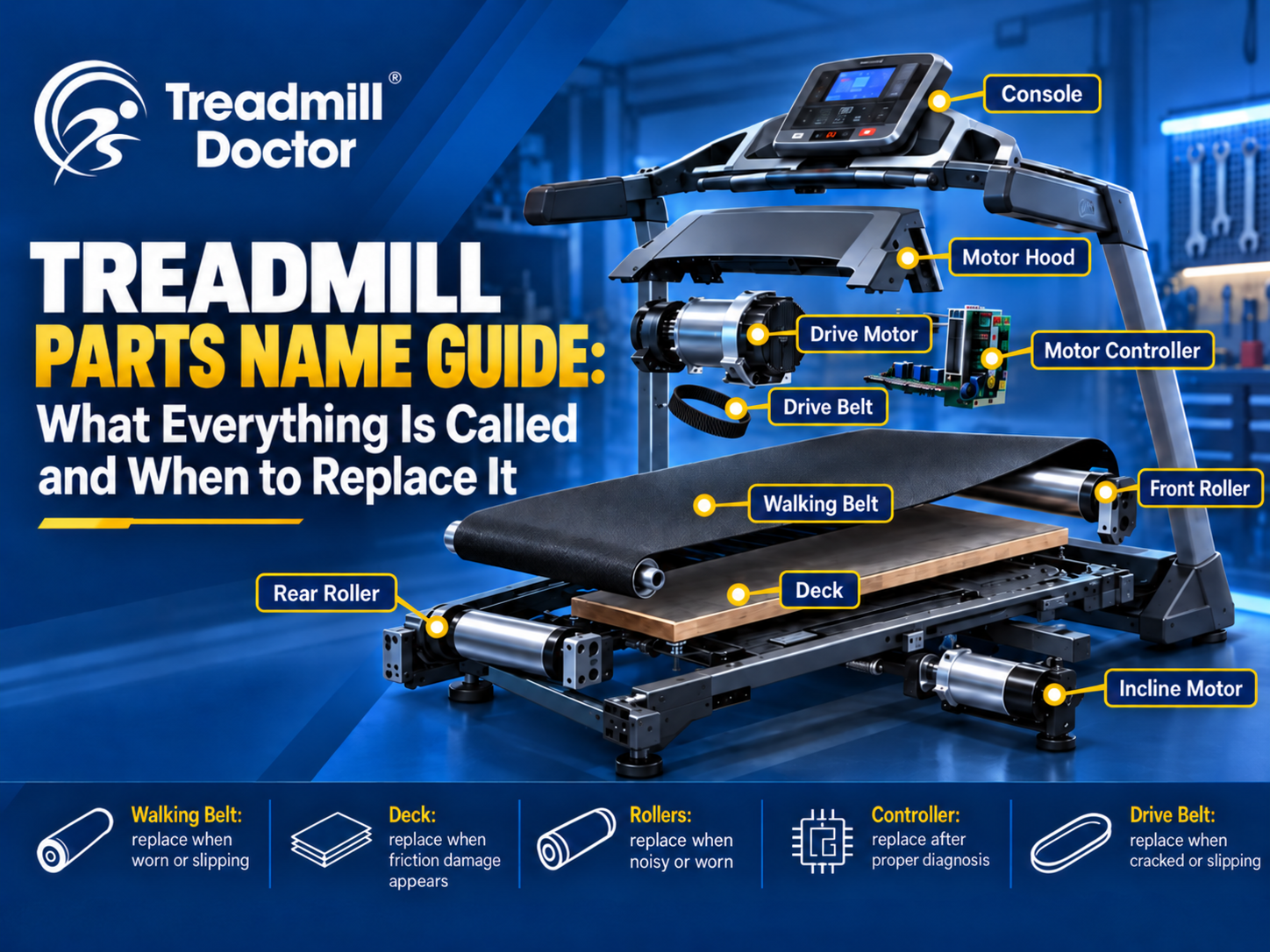
Treadmill parts name guide: what everything is called and when to replace it
If you have ever stared at a treadmill part and thought, what do I even call this so I can order it, you are not alone. Model names look similar, component names get mixed up, and one wrong guess can mean lost time and repeat labor.
This guide names each major treadmill part, shows the symptoms that point to it, suggests quick tests, and flags paired replacements that save headaches. Keep your model and serial numbers handy. If anything is unclear, Treadmill Doctor can confirm compatibility with free remote diagnostics so you get it right the first time.
Safety first: unplug the unit before opening motor covers or removing leads. Keep hands, hair, and clothing away from moving belts and pulleys during any live testing.
Walking belt vs drive belt
Walking belt: the large belt you run or walk on.
Drive belt: the smaller belt under the motor cover that connects the drive motor pulley to the front roller.
When to replace:
Walking belt: replace when it is glazed, cracked, fraying, slipping under load, or leaves fine black dust. If the deck shows grooves or burn marks, replace the belt and inspect the deck.
Drive belt: replace when it slips, squeals, shows glazing or cracks, or has loose tension that cannot be corrected.
Quick tests:
Lift the walking belt mid-deck. If you can easily lift it more than 3 inches, it is likely too loose.
Feel under the belt for dry or gritty spots on the deck. Dry friction points to lube or wear issues.
Observe start-up. A slow or jerky start can be a worn belt, a dry deck, or a failing drive motor and motor controller.
Pro Tip: When it is time to replace the walking belt, replace the drive belt too. This restores balanced traction, reduces strain on the drive motor and motor controller, and avoids repeat labor. Browse precision walking belts and drive belts in the treadmill parts section or explore the Gym Tough Pro line engineered to meet or often exceed OEM specs.
Deck
What it is: the board beneath the walking belt. Many are reversible.
When to replace:
Deep grooves, burn marks, delamination, or a rough surface even after lubrication. If one side is worn and your model supports flipping, you can rotate once before full replacement.
Quick test:
With power unplugged, slide a hand between belt and deck. If it feels dry, rough, or has ridges, address lubrication first; replace the belt and deck if damage is present.
Rollers and bearings
What they are: front and rear rollers guide and move the belt; bearings sit inside roller ends.
When to replace:
Squeaking, chirping, grinding, or drag when spun by hand; visible wobble; belt tracking that will not hold after proper adjustments.
Quick test:
Unplug, remove motor cover, and rotate rollers by hand. A smooth, quiet spin is healthy.
Pro Tip: To isolate a noisy bearing, use an engine stethoscope or place the tip of a long screwdriver on the bearing housing and your ear against the plastic handle end while turning the roller by hand. Unplug the unit, secure the safety key if applicable, and keep hands clear of moving parts.
Drive motor and motor controller
What they are:
Drive motor: the physical motor that turns the front roller.
Motor controller, also called control board: the electronics that power and regulate the drive motor.
Symptoms:
Erratic speed, delayed start, stalling under load, burning smell, repeated blown fuses, or no movement though the console powers.
Quick tests:
Controller output check: with proper live-test safety, command a low speed and measure the controller’s DC output to the motor. You should see a low DC that ramps as speed increases. An immediate high DC on power-up often signals a shorted controller output.
Bench motor test: unplug the unit, remove motor leads, and briefly power the motor with a known low-voltage DC source like a cordless drill battery. Black to negative, red to positive. A good motor spins smoothly and reverses when leads are swapped.
Can a treadmill motor be replaced?
Yes, drive motors can typically be replaced once diagnosed. Always verify the controller and motor together because a failing belt or controller can mimic a weak motor.
Incline motor
What it is:
Incline motor: raises and lowers the deck.
Incline output circuits are typically handled by the motor controller.
Symptoms:
Stuck incline, clicking without movement, or drifting incline.
Quick tests:
Listen for motor engagement. Inspect wiring harness plugs. Check for obstruction under the frame. Calibrate incline if your model supports it.
Console
What it is:
Console: shows speed, time, distance, and sends control commands.
Symptoms:
Dead screen, unresponsive buttons, flicker, or resets.
Quick tests:
Verify outlet power and cord seating. Try a known-good non-GFCI outlet if nuisance trips occur.
Pro Tip: Many manufacturers recommend avoiding GFCI outlets for treadmills, which can trip from inrush current. Test a non-GFCI outlet if trips persist and follow local code and safety guidance.
For deeper power-on troubleshooting, see this no-power checklist from Treadmill Doctor.
Safety key or safety switch
What it is: a required magnetic key or switch that enables operation.
Symptoms:
Console lights but Start does nothing, or unit will not power.
Quick tests:
Reseat or replace the key. Inspect the reed switch if applicable.
Wiring harness and connectors
What it is: the cable network linking console, controller, motors, and sensors.
Symptoms:
Intermittent operation, incline that works only at certain angles, or random shutoffs.
Quick tests:
Unplug and inspect for pinched, corroded, or loose connectors. Reseat firmly.
Fuses
What they are: board-mounted or inline protection devices.
Symptoms:
Total loss of power or repeated failures.
Quick tests:
Match the exact type and rating when replacing. Some are fast-blow, others slow-blow.
Pro Tip: Fuses come in fast-blow and slow-blow (time-delay). Replace with the exact same type and rating. If you are unsure, Treadmill Doctor can advise before you order.
Side rails and fasteners
What they are:
Side rails: the plastic or metal trims along the deck.
Fasteners: screws, bolts, nuts, and clips that hold assemblies.
When to replace:
Cracked rails, stripped threads, missing bolts, or hardware that will not hold alignment lead to belt tracking problems and squeaks.
Ordering checklist and compatibility tips
Before you add to cart:
Model and serial numbers, including revision or version codes from the data sticker.
Production run date if present.
Photos of the old part and labels if possible.
How Treadmill Doctor helps:
Free diagnostics to confirm the root cause and exact part number for your unit.
Compatibility checks across internal model variations that share a name but not the same parts.
Fast shipping with visible lead times on product pages.
Pro Tip: If your walking belt is due, order the drive belt at the same time. It is the cleaner, first-time fix and keeps loads down on the drive motor and motor controller.
Common treadmill mistakes to avoid
Guessing at part names or numbers instead of confirming by model and serial.
Replacing only the walking belt when the drive belt is also worn.
Ignoring deck condition and lubrication.
Tightening a slipping belt without addressing glazing or drive belt tension.
Skipping dust cleaning under the motor cover. Dirt accumulation is the number one enemy of proper functioning.
Using the wrong fuse type or an outlet that repeatedly trips.
Quick FAQ
What are the parts of a treadmill called?
Core parts include the walking belt, drive belt, deck, front and rear rollers with bearings, drive motor and motor controller, incline motor, console, safety key or switch, wiring harness, fuses, side rails, and fasteners.
What are common treadmill problems?
Belt slip or drift, dry deck friction, noisy rollers or bearings, erratic speed, incline stuck, console not powering, repeated blown fuses, and intermittent wiring connections.
What are common mistakes to avoid?
Ordering without model and serial confirmation, replacing one worn belt without the other, over-tightening belts to mask wear, neglecting cleaning and lubrication, and using the wrong fuse type.
Can a treadmill motor be replaced?
Yes. Drive motors are replaceable once diagnosed. Test both the drive motor and motor controller to identify the true fault before ordering.
Typical life expectancy depends on use, environment, and care: quality residential treadmills often last 7 to 12 years with proper maintenance.
Next steps
Need precision-fit treadmill parts now? Browse the full treadmill parts catalog and search by model and serial.
Unsure what you need? Use Treadmill Doctor free diagnostic services to confirm the exact component and avoid misorders.
Looking for USA-made, engineered alternatives that meet or often exceed OEM specs? Explore the fitness equipment replacement parts selection across brands.
Helpful links:
Troubleshoot deeper power issues with this guide to no power to treadmill.
Find a replacement walking belt or plan your treadmill belt replacement with model-specific fitment pages.
If your brand uses a specific controller, review model-matched control boards including options like a NordicTrack control board when appropriate.
Summary: Knowing proper part names and the symptoms that point to each component helps you order once and fix it right. Unplug before opening covers, match fuses exactly, avoid GFCI trips where applicable, and replace paired wear items together. If you want a second set of eyes, Treadmill Doctor can diagnose and confirm compatibility at no charge so your machine gets back to smooth, quiet miles.