
Treadmill No-Power Diagnostics Before Replacing Control Board
 Fitness
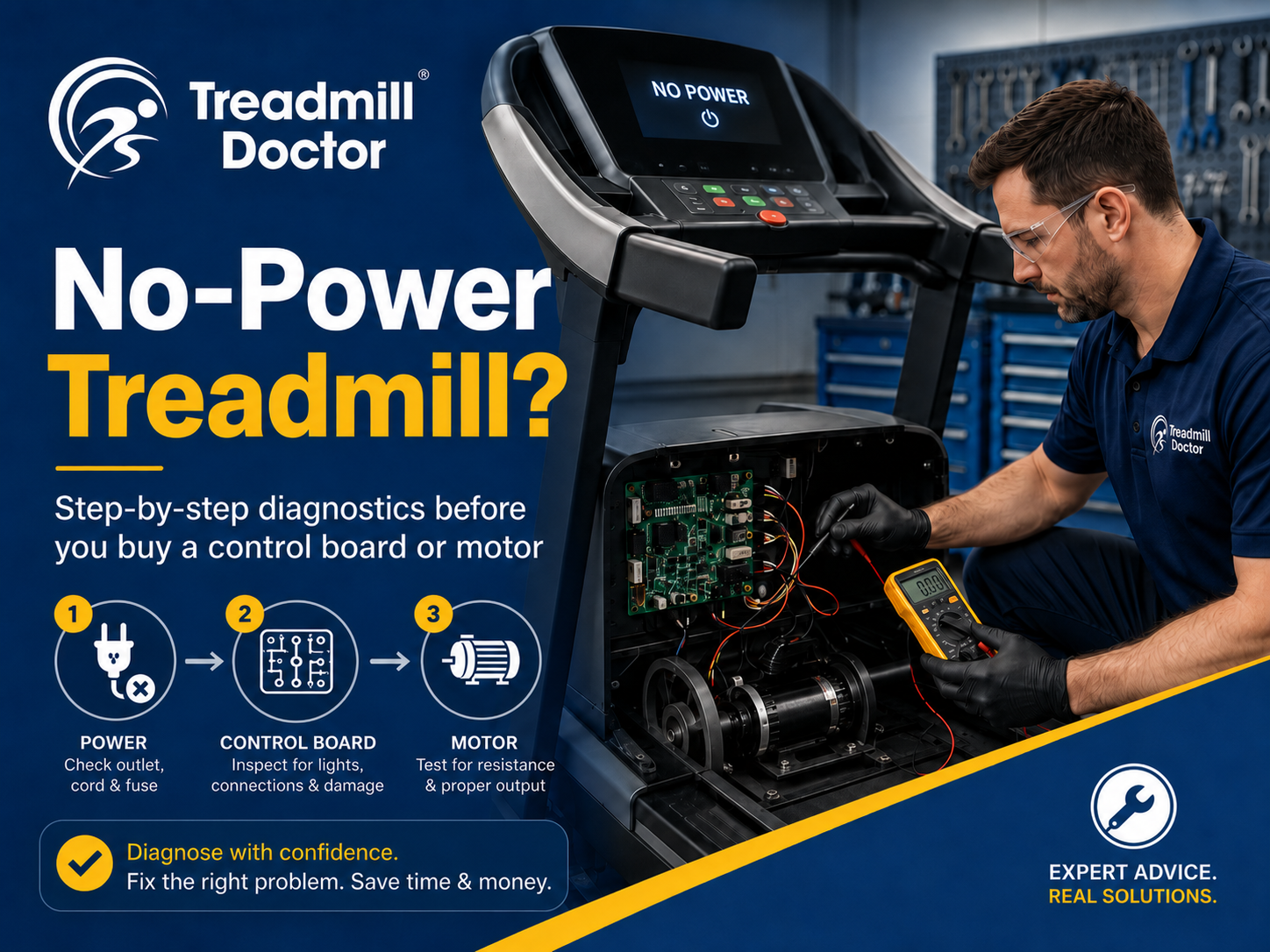
No-Power treadmill? Step-by-step diagnostics before you buy a control board or motor
A treadmill that will not power on can feel like a dead end. Before you order a motor controller or drive motor, a few targeted tests can quickly separate a simple fix from an electronics failure.
This guide walks you through safe, practical checks you can do at home. You will verify power basics, confirm the console’s role, test the motor controller output with a multimeter, bench test the DC drive motor, and follow a clear decision path to the right part. The goal is to reduce guesswork, prevent misorders, and get you running again with confidence.
If you want help at any point, Treadmill Doctor offers free remote diagnostic services. Share your model and serial number, and an expert will confirm the exact part before you buy.
Safety first
Unplug the unit before opening motor covers or disconnecting any leads (if equipped). For live tests, secure the treadmill, keep the deck clear, have the safety key within reach, and use insulated probes. Never bypass safeties or jump unknown terminals.
Quick power checks that solve many no-power calls
Work through these in order. Many no-power symptoms trace back to simple items.
Verify the outlet and breaker. Plug in a lamp or tester to confirm the circuit is live.
Pro Tip: Many manufacturers advise avoiding GFCI-protected outlets on treadmills. Startup inrush current can trip a GFCI. If you have repeat trips, try a non-GFCI outlet while following local code and safety guidance.
Seat the power cord. Check both ends for a firm connection and look for damage near strain reliefs.
Insert the safety key. Many treadmills will not power or start without a fully seated safety key or switch.
Inspect fuses. Look for an inline fuse near the cord, a fuse on the motor controller, or a board-mounted fuse (if equipped). Replace only with the same type and rating.
Pro Tip: Fuses come in fast-blow and slow-blow (time-delay). Always match the exact rating and type. If unsure, ask a Treadmill Doctor tech to confirm before replacing.
Scan the wiring harness. With power unplugged, reseat connectors to the console, motor controller, and any inline connectors. Check for bent pins, corrosion, pinched cables, or heat discoloration.
If these pass and you still have no response, it is time to test the console path and controller-to-motor chain.
What the console does and why it matters
The console displays speed, distance, time, and incline, and it sends control commands to the motor controller on treadmills. On ellipticals and bikes it commands the resistance motor or actuator (if equipped). If the console is dark but you have a live outlet and good fuses, you may have a failed console or power supply path. If the console lights but the belt will not move, focus on the motor controller and drive motor.
Controller output test with a multimeter
This is the fastest way to decide whether the motor controller or the drive motor is at fault.
Setup
Unplug the treadmill. Remove the motor cover (if equipped). Identify the two DC motor leads, typically red and black, connected to the motor controller output.
Secure your meter for DC volts. Clip the black probe to controller negative output first, then place the red probe on controller positive output. Ensure leads are safe and clear.
Live test
Plug in the treadmill. Insert the safety key. Command the lowest belt speed.
Observe DC output across the motor leads.
Expected behavior
A healthy motor controller ramps up a low DC voltage as commanded speed increases.
If you see an immediate high DC voltage at power-up before you command speed, that points to a shorted controller output stage. Replace the motor controller.
If the controller output ramps normally but the motor does not turn, suspect the drive motor or a mechanical bind.
Note: If the fuse blows during the ramp or output jumps erratically, recheck for shorted wiring, seized rollers, or an over-tight or glazed walking belt and drive belt that can overload the controller and motor.
Bench test the DC drive motor
This isolates the motor from the controller.
Unplug the treadmill. Label and disconnect the motor leads.
Using a known low-voltage DC source, such as a cordless drill battery, briefly connect red to positive and black to negative. Expect a slow, smooth spin. Reverse polarity and the motor should spin the other direction.
No movement, rough grind, sparking, or a locked shaft indicates a failing motor. Replace the drive motor. If it runs smoothly, the motor is likely fine and the issue points back to the motor controller or upstream commands.
Mechanical load matters
A worn or over-tight walking belt or drive belt can stall the drive system and trip fuses. Check belt condition, tension, and deck lubrication. Replace walking and drive belts together when glazed, frayed, slipping, or leaving black dust. This reduces heat and strain on the motor and motor controller.
If you need a precision-fit walking belt or drive motor, Treadmill Doctor stocks a wide range of treadmill parts with visible lead times and fast shipping.
Decision path to the right part
Use your test results to choose the next step:
No console power after outlet and fuse checks: console or its power supply path. Inspect the console harness.
Console lights, controller shows no DC output when speed is commanded: motor controller likely failed.
Controller shows immediate high DC at power-up: replace the motor controller.
Controller ramps DC normally, motor does not move on the bench test: replace the drive motor.
Controller ramps DC, motor passes bench test, but belt will not move under load: look for seized rollers, rough bearings, mis-tracking, or worn walking and drive belts.
Blown fuses repeat: confirm exact fuse type, inspect wiring for shorts, verify belts and rollers are not binding, then re-evaluate controller and motor as a pair.
When controller failures are confirmed, also assess motor health. Pair replacements can be the most reliable fix on older machines where both components have aged together.
Short FAQ
What are common treadmill problems?
Power issues, missing safety keys, blown fuses, worn walking belts and drive belts, noisy or rough rollers and bearings, failing motor controllers and drive motors, and console power faults.
What is the most common problem with a treadmill?
For no-power symptoms, it is often basic power path issues, a missing safety key, or a blown fuse. For no-movement with power, worn belts or a failing motor controller and drive motor are frequent.
Can a treadmill motor be replaced?
Yes. Drive motors are replaceable, and Treadmill Doctor can match a precision-fit motor to your model and serial. Always evaluate the motor controller at the same time.
What are signs of a bad treadmill motor?
Burning smells, loud arcing or grinding, severe brush sparking, stalled starts under light load, and failure in a bench test with a low-voltage battery point to motor trouble.
Can a treadmill be repaired?
Typically yes. With accurate diagnostics, replacing a motor controller, drive motor, walking belt, drive belt, rollers, or fuses can restore performance.
Typical life expectancy depends on use, environment, and care:
Treadmills: residential models often run 7 to 12 years with proper maintenance.
Need parts or a second set of eyes?
If you are facing no power to a treadmill and want a deeper checklist, read Treadmill Doctor’s guide on how to fix a treadmill that will not turn on. For brand-specific controller needs, browse options like a NordicTrack control board if your diagnosis points there. If you prefer structured troubleshooting and part confirmation, start with free diagnostic services and then order precision-fit parts with clear lead times.
Summary: Verify basics, test the controller’s DC ramp, bench test the motor, and correct any mechanical load issues. This short sequence answers 90 percent of no-power or no-movement questions without guesswork.