
Orthopedic Treadmill Belts: Comfortable? Absolutely. Better? It Depends.
 Health
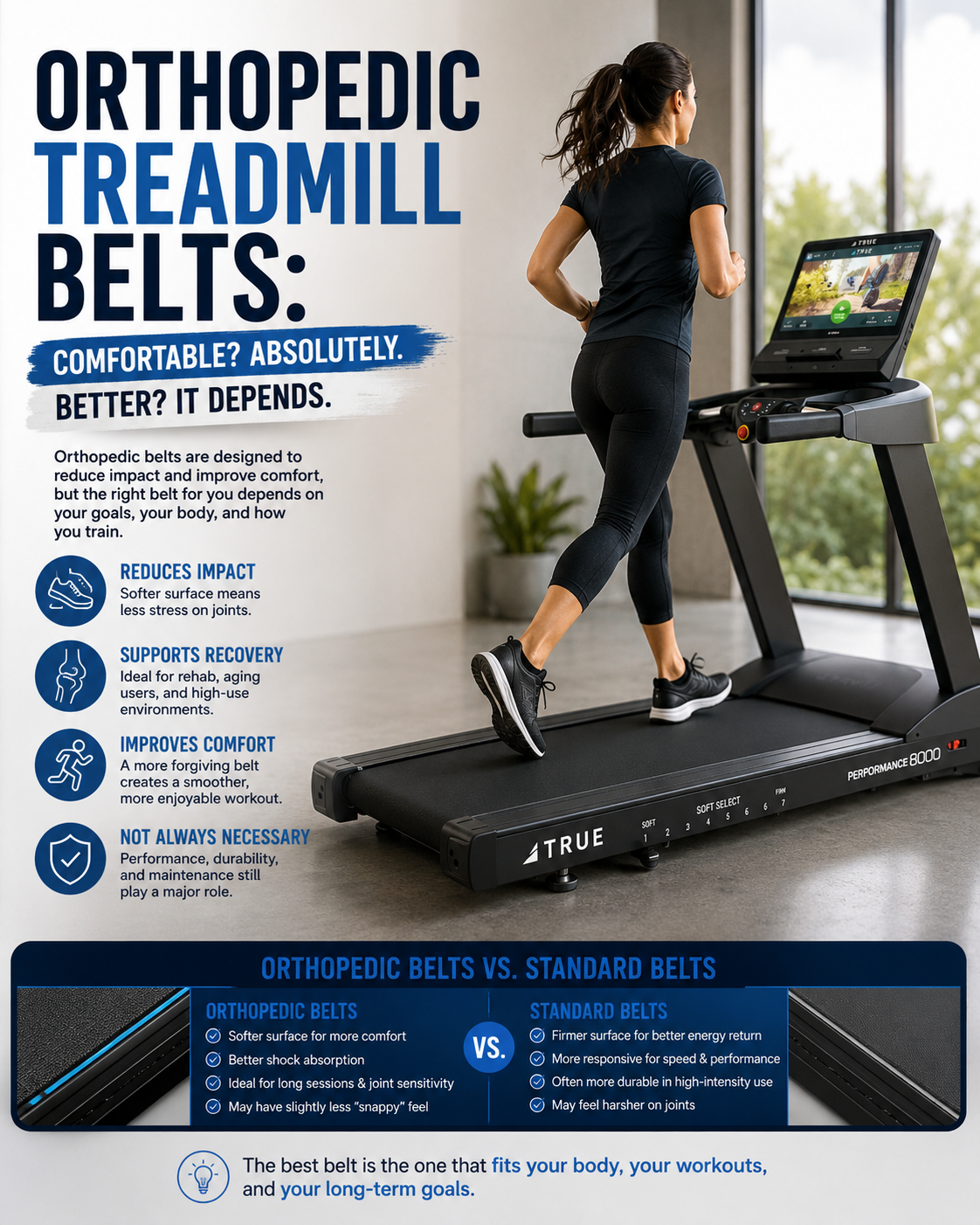
Orthopedic Treadmill Belts: Comfortable? Absolutely. Better? It Depends.
One of the most common questions we receive at Treadmill Doctor is whether someone should upgrade to an orthopedic treadmill belt.
The answer, like most things in engineering, is: it depends.
Why Manufacturers Use Orthopedic Belts
There's a reason many treadmill manufacturers install orthopedic belts from the factory.
They feel great.
An orthopedic belt is substantially thicker than a traditional high-quality walking belt—often by an order of magnitude. That additional material creates a softer, more forgiving running surface that many users immediately notice. If you're shopping for a treadmill in a showroom, the one with the orthopedic belt often feels more luxurious.
That's not marketing hype. It genuinely is more comfortable.
Unfortunately, physics doesn't give away free lunches.
The Trade-Off Nobody Talks About
The same thickness that creates a softer feel also creates problems.
A thicker belt:
Holds more heat.
Weighs significantly more.
Requires more energy to move.
Causes the drive system to operate using more energy.
The added topcoat also will “sluff-off” it’s material, creating far more belt dust at the rear of the treadmill.
Energy usage isn't just a number on a meter. It translates directly into more stress throughout the entire treadmill.
Over time, that additional load can shorten the life of:
The walking belt
The deck
The front and rear rollers
The drive motor brushes and windings
The motor controller (electronics)
It's simply more work for every component involved.
This isn't a design flaw. It's physics.
Can Engineering Eliminate These Downsides?
Not entirely.
Over the years, one company has impressed us more than most in this area: True Fitness.
True's belt and deck system and overall engineering does an excellent job of reducing many of the disadvantages typically associated with orthopedic belts. Their engineering is among the best we've seen.
But even exceptional engineering has limits.
No manufacturer can completely overcome the laws of physics. More mass still requires more energy. More thickness still traps more heat.
Engineering can reduce the compromise.
It cannot eliminate it.
So, Should You Buy One?
Here's where the human element enters the equation.
Not every treadmill decision should be made solely to maximize component life.
If you suffer from arthritis, chronic joint pain, previous injuries, or other orthopedic conditions, the additional cushioning may be well worth the trade-off.
Sometimes protecting your knees, hips, or back is far more valuable than squeezing another year or two out of a motor controller.
After all, treadmill parts can be replaced.
Your knees cannot without considerable effort and pain.
What Do I Personally Choose?
People often ask what I use on my own treadmill.
Even though I deal with orthopedic issues myself, I still choose a traditional high-quality treadmill belt for my home machine.
I also keep a pair of Hoka sneakers available to use on the machine. In a perfect world, I would only use them on the treadmill, but they are expensive. The Hoka’s give me much better cushioning than a regular pair of shoes so it compensates.
For me, the increased efficiency, lower operating temperatures, and longer component life outweigh the extra cushioning.
Would I buy a True Fitness treadmill with an orthopedic belt in the future?
Very possibly.
Time has a way of changing all our priorities.
Gravity eventually wins every argument, and our joints don't get younger.
When that day comes, I'll gladly accept the engineering trade-offs for the added comfort.
Our Recommendation
There isn't a universally "best" treadmill belt.
There's only the belt that's best for your situation.
If your priority is maximum durability, lower operating temperatures, and the longest possible life from your treadmill, a high-quality traditional walking belt is usually the better choice.
If your priority is reducing impact on aging or injured joints, an orthopedic belt can be an excellent investment—as long as you understand the compromises that come with it.
At Treadmill Doctor, we'd rather help you make an informed decision than simply sell you the most expensive option.
Because unlike marketing...
Physics always tells the truth.